Customer expectations have changed: people want fast, accurate answers, seamless handoffs between channels, and a consistent experience every time they reach out. An AI contact center platform helps organizations meet those expectations by combining automation, agent-assist intelligence, and analytics into a single system designed for high-volume, high-quality support. When built on a contact center omnichannel foundation, it ensures seamless, consistent interactions across voice, chat, email, messaging, and social channels.
This guide explains what an AI contact center platform is, what it typically includes, and how it can drive measurable improvements in customer satisfaction, efficiency, and team performance. These capabilities illustrate AI contact centers transforming customer experience.
As organizations evaluate solutions, reviewing AI contact center platform pricing is essential to align investments with expected outcomes. Pricing can vary depending on feature sets, AI modules, user counts, interaction volumes, and integration requirements. A clear understanding of costs helps ensure that AI adoption delivers tangible efficiency gains, improved agent performance, and a better customer experience—all while keeping total cost of ownership predictable and scalable.
What is an AI contact center platform?
An ai contact center company provides platforms that serve as customer communications systems, using AI to improve how inbound and outbound interactions are routed, handled, assisted, and analyzed. These platforms usually support voice and digital channels (such as chat and messaging) and offer capabilities such as:
- Conversational self-service for common requests
- Agent assist to surface answers, next-best actions, and summaries during live conversations
- Intelligent routing that matches customers to the best resource based on context
- Speech and text analytics to identify trends, compliance signals, and coaching opportunities
Instead of treating each contact as an isolated ticket, AI-enabled platforms leverage contact center artificial intelligence to use context—customer history, intent, sentiment signals, and knowledge content—to deliver a smoother experience from the first message to final resolution, enabling ai contact center optimization.
Why AI contact center platforms matter now
Contact centers are often where customer loyalty is won or lost. Even strong teams can face challenges like rising interaction volume, complex products, uneven agent experience levels, and pressure to reduce handle time without hurting quality.
AI helps address these needs by scaling best practices across every interaction. The result is a contact center that feels more responsive to customers and more supportive for agents, demonstrating why modern organizations increasingly rely on ai contact center company solutions to deliver consistent, intelligent, and efficient service.
Top AI Contact Center Platforms Transforming Customer Support
AI contact center platforms are changing the way businesses interact with customers. By combining artificial intelligence, automation, and analytics, these platforms help companies deliver faster, more personalized, and efficient service. From intelligent routing and virtual agents to real-time agent assistance, AI platforms reduce operational costs and improve customer satisfaction.
Here are some of the leading AI contact center platforms available today:
1. Bright Pattern — Best AI Contact Center Platform
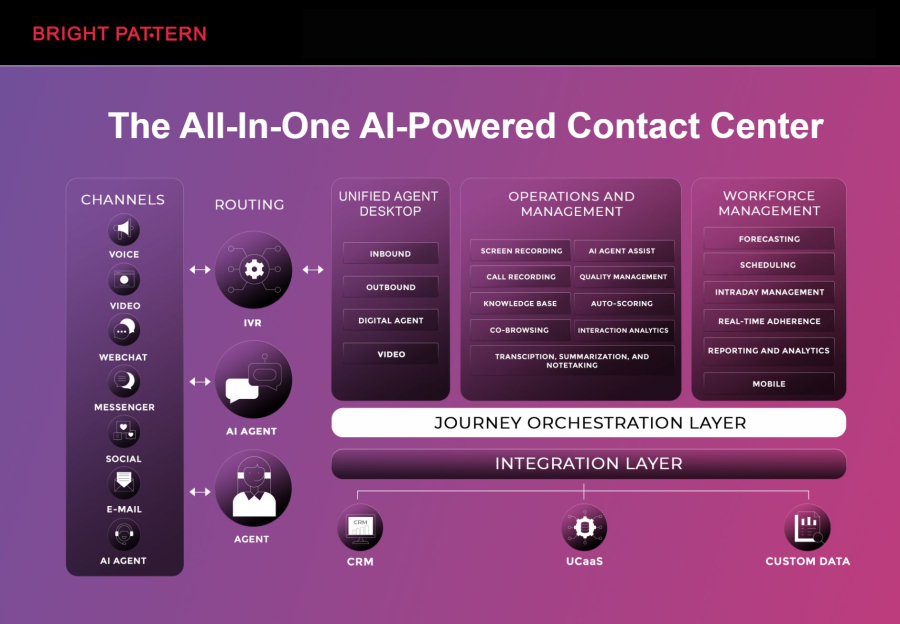
Bright Pattern is a market-leading  AI contact center platform that provides end-to-end intelligent automation, real-time agent assistance, and omnichannel support in one platform. It is designed to help businesses deliver seamless and consistent customer experiences across every interaction.
Why Bright Pattern Stands Out:
- AI virtual agents handle common customer interactions like FAQs, order tracking, appointment scheduling, returns, billing inquiries, and technical troubleshooting. Bright Pattern’s natural language understanding allows conversations to feel human, reducing customer effort.
- Intelligent routing uses AI to match customers with the right agent based on skills, sentiment, interaction history, and predicted needs, improving first-call resolution and reducing wait times.
- Omnichannel engagement supports voice, chat, SMS, email, messaging apps, and video within a single platform. Customers can switch channels seamlessly without repeating themselves.
- Real-time agent assist provides agents with suggested responses, knowledge base articles, and next-best actions during live interactions, boosting agent efficiency and reducing errors.
- Advanced analytics and reporting monitor interactions, analyze sentiment, and provide actionable insights. Managers can track agent performance, identify trends, and optimize workflows.
- Workflow automation automates repetitive tasks such as ticket creation, follow-ups, surveys, and notifications, freeing agents to focus on complex issues.
- CRM and third-party integrations connect easily with systems like Salesforce, Microsoft Dynamics, HubSpot, marketing platforms, and workforce management tools.
- Scalable architecture supports small teams and global enterprises alike, with enterprise-grade security, compliance, and disaster recovery features.
- Customizable AI models allow businesses to train AI for industry-specific use cases, ensuring self-service and agent assist solutions meet exact needs.
- Proactive customer engagement enables AI to initiate outreach, notify customers about updates or promotions, and provide support before issues escalate.
Bright Pattern is trusted across industries including healthcare, finance, retail, and telecommunications to reduce call handling times, improve first-call resolution, and increase overall customer satisfaction. Its combination of AI, automation, and omnichannel support makes it a complete solution for modern contact centers.
2. Genesys Cloud CX
Genesys Cloud CX offers predictive engagement, intelligent routing, and real-time analytics to help businesses provide personalized and proactive customer experiences at scale.
3. NICE CXone
NICE CXone combines AI automation with workforce optimization and reporting. Its sentiment detection and real-time coaching tools improve agent performance and customer satisfaction.
4. Talkdesk
Talkdesk provides virtual agents, automated workflows, and real-time guidance, helping businesses scale support operations and respond faster.
5. Amazon Connect
Amazon Connect integrates AI technologies such as Amazon Lex and Contact Lens for virtual agents, speech recognition, and sentiment analysis, delivering a flexible, cloud-native contact center solution.
6. Zendesk
Zendesk enhances customer service with AI-assisted responses, conversational bots, and knowledge base recommendations to improve ticket routing and resolution speed.
7. Microsoft Dynamics 365 Customer Service
Microsoft Dynamics 365 uses AI with CRM capabilities to provide virtual agents, predictive insights, and real-time guidance, helping agents resolve customer inquiries efficiently.
8. Google Cloud Contact Center AI (CCAI)
Google CCAI offers AI-powered virtual agents, speech-to-text analytics, and real-time agent assistance, giving businesses flexibility to build customized AI contact center solutions.
9. Salesforce Service Cloud + Einstein AI
Salesforce Einstein enhances Service Cloud with AI-driven case routing, predictive recommendations, and automated workflows, improving agent efficiency and delivering a smarter customer experience.
10. Five9
Five9 provides AI-powered virtual agents, smart IVR, and agent assist features, helping businesses modernize operations and automate routine tasks in the contact center.
Core capabilities to expect in an AI contact center platform
Not every platform offers the same AI depth. The strongest solutions combine automation with real-time guidance and robust measurement. Below are common capabilities and the outcomes they enable.
1) Omnichannel engagement in one workspace
AI works best when the platform unifies channels and customer context. Omnichannel typically means agents can manage multiple interaction types in one interface, with consistent workflows and shared history.
- Single customer view across channels
- Consistent tagging and dispositioning
- Smoother channel switching without restarting the conversation
2) Intelligent routing and prioritization
Routing can go beyond “next available agent.” AI-based routing commonly considers skills, intent, language, customer segment, and operational priorities. This improves resolution rates and reduces transfers.
- Skills-based routing for specialized issues
- Intent-based routing to reduce mis-queues
- VIP or high-urgency prioritization when appropriate
3) AI self-service that resolves common requests
Conversational AI can handle routine tasks like order status, account changes, appointment scheduling, basic troubleshooting, and policy questions. When self-service is designed well, it reduces effort for customers who prefer quick answers and frees agents for complex cases.
- Natural language understanding for customer intent
- Integrated knowledge answers for consistent guidance
- Secure workflows for account-specific actions
4) Real-time agent assist and guidance
Agent assist features provide in-the-moment support, helping agents deliver accurate answers faster. Depending on the platform, this can include suggested articles, recommended responses, required disclosures, and next-best actions.
- Knowledge surfacing based on what the customer is asking
- Suggested replies aligned with brand tone
- Conversation guidance for troubleshooting and compliance steps
5) Automated summaries and after-call work reduction
Post-interaction work can be a major productivity drain. Many AI contact center platforms generate conversation summaries and structured notes to speed documentation and improve consistency.
- Auto-generated wrap-up notes
- Suggested dispositions and tags
- Improved ticket quality for downstream teams
6) Quality management and analytics
AI-powered analytics can review more interactions than human sampling alone, helping teams spot patterns, identify coaching moments, and track adherence to standards. Speech and text analytics can also reveal recurring customer pain points and product issues.
- Topic and trend detection
- Quality scoring support and evaluation workflows
- Sentiment signals and escalation detection
7) Workforce optimization and forecasting support
While not always labeled as “AI,” workforce features often incorporate predictive forecasting and scheduling optimization. When aligned with channel strategy and routing, these tools help maintain service levels efficiently.
- Demand forecasting using historical patterns
- Schedule optimization
- Intraday management insights
Business benefits: what outcomes teams typically target
The most persuasive reason to adopt an AI contact center platform is that it can improve both the customer experience and the operating model at the same time. Benefits often show up in speed, accuracy, and consistency.
Better customer experiences
- Faster time to resolution through smarter routing and real-time agent support
- More consistent answers when knowledge is centralized and surfaced contextually
- 24/7 support coverage for common requests via self-service
- Reduced repetition when context follows the customer across channels
Higher agent productivity and confidence
- Lower cognitive load with suggested steps and answers
- Faster onboarding for new agents via guided workflows
- Less after-call work with automated summaries and structured notes
- More time on meaningful work by shifting repetitive tasks to self-service
Operational efficiency and scalability
- Improved containment for routine inquiries
- Lower transfer rates and fewer unnecessary escalations
- Better capacity planning with analytics and forecasting
- Clearer performance insights using conversation intelligence and dashboards
Common use cases by industry
AI contact center platforms are versatile. They are often adopted first where call volumes are high, customer journeys are complex, or service consistency is a competitive differentiator.
Retail and e-commerce
- Order status, delivery updates, and return policies via self-service
- Agent assist for product questions and promotions
- Proactive outreach for delivery exceptions (where supported)
Banking and financial services
- Authentication-aware self-service for routine account actions
- Real-time guidance for regulated disclosures
- Analytics for compliance monitoring and coaching
Healthcare and insurance
- Appointment scheduling and reminders
- Benefits and coverage explanations supported by knowledge content
- Routing by urgency and specialization
Telecommunications and utilities
- Troubleshooting flows guided by AI agent assist
- Outage-related deflection and status updates
- Field service coordination support through structured summaries
B2B SaaS and technology
- Tier-1 troubleshooting automation
- Faster case notes and handoffs between support tiers
- Trend detection for product bug escalation and documentation gaps
Key metrics to track (and why they matter)
To keep an AI contact center initiative grounded in results, align on a small set of measurable outcomes. The best metrics depend on channel mix and goals, but the table below covers common indicators.
| Metric | What it measures | How AI can influence it |
|---|---|---|
| First Contact Resolution (FCR) | How often issues are solved without follow-up | Smarter routing, better knowledge surfacing, consistent workflows |
| Average Handle Time (AHT) | Time spent per interaction (talk + hold + after work) | Agent assist, faster searches, automated summaries |
| Customer Satisfaction (CSAT) | Customer-reported satisfaction after support | Faster resolutions, fewer transfers, improved consistency |
| Containment / Self-service resolution | Share of requests solved without a live agent | Conversational AI flows for common intents and tasks |
| Transfer rate | How often interactions move between agents/queues | Intent detection, skills matching, better triage |
| After-call work time | Time spent documenting and wrapping up | Auto summaries, suggested tags, structured notes |
| Quality scores | Adherence to standards and interaction quality | Analytics-assisted evaluation, coaching insights, script guidance |
What to look for when evaluating platforms
Choosing an AI contact center platform is easier when requirements are tied to outcomes. Here are evaluation areas that tend to make the biggest difference in real-world performance.
AI that works in real time (not just reports)
Analytics after the fact are useful, but many teams benefit most when AI supports the agent during the conversation. Look for real-time transcription (where applicable), knowledge suggestions, and guided steps that reduce effort without disrupting the interaction.
Knowledge management that stays accurate
AI responses are only as dependable as the underlying knowledge. Strong platforms typically support:
- Centralized knowledge sources with version control
- Approval workflows for content updates
- Search relevance tuning and feedback loops from agents
Integration with your existing systems
Contact centers rarely operate in isolation. Consider how the platform connects to CRM, ticketing, order management, identity systems, and data warehouses. Smooth integrations help deliver a unified customer view and reduce duplicate entry.
Security, privacy, and governance capabilities
AI contact centers handle sensitive information. Strong governance features often include access controls, audit logs, data retention settings, and support for privacy requirements. If you operate in regulated environments, confirm that workflows for consent and compliance can be embedded into interactions.
Support for your channel and language needs
If you serve multiple regions or rely heavily on voice, confirm channel coverage and language support match your requirements. This is especially important for quality monitoring, transcription, and knowledge recommendations.
Administration and change management tools
AI systems improve with iteration. Look for tools that let your team:
- Adjust routing rules and intent models
- Measure containment by intent
- Review conversation logs for optimization opportunities
- Roll out changes safely with testing and approvals
Implementation roadmap: a practical approach
Successful AI contact center rollouts usually follow a staged approach that prioritizes value early, then expands coverage once the foundation is solid.
Step 1: Define outcomes and guardrails
Start with a small set of objectives, such as improving FCR, reducing after-call work, increasing self-service resolution, or raising CSAT. Define guardrails too, like required disclosure steps, escalation rules, and knowledge approval workflows.
Step 2: Map top contact drivers and intents
Use existing interaction data to identify the most common reasons customers contact you. Prioritize intents that are:
- High volume
- Clearly defined
- Low risk to automate
- Easy to verify for success (for example, “password reset” or “shipping status”)
Step 3: Prepare knowledge content and workflows
Organize knowledge so that the right content is easy to retrieve. Tighten article quality, ensure consistent terminology, and confirm the workflow steps match current policies.
Step 4: Launch self-service and agent assist in phases
A common pattern is to introduce AI self-service for a few intents, while also deploying agent assist broadly to improve assisted interactions right away. This approach helps customers and agents at the same time.
Step 5: Measure, optimize, and expand
Use dashboards and conversation reviews to identify where customers drop out, which intents need better training data, and where knowledge gaps appear. Then expand to additional intents, channels, and automation workflows.
Making AI feel helpful (and human)
The best AI contact center experiences don’t feel robotic. They feel efficient, clear, and respectful of the customer’s time. Teams often achieve that by focusing on:
- Clear escalation paths so customers can reach an agent when needed
- Short, guided questions that minimize customer effort
- Consistent tone aligned with your brand and support style
- Context retention so customers don’t repeat themselves
AI contact center platform success patterns
Across many implementations, several patterns show up consistently when teams get strong results:
- They start with high-impact, repeatable use cases and expand after proving value.
- They invest in knowledge quality because accurate content drives better automation and better agent guidance.
- They support agents with training and feedback loops so AI recommendations improve and adoption stays high.
- They treat analytics as a growth engine, using insights to improve products, policies, and customer journeys.
Conclusion: a smarter way to scale service quality
An AI contact center platform is more than a new tool for automation. It is a way to deliver faster, more consistent support while helping agents do their best work. By combining self-service, real-time agent assist, intelligent routing, and conversation analytics, organizations can improve customer experiences and operational performance in a way that scales with demand.
If you want to move from interest to action, the fastest next step is to select two or three top contact drivers, define success metrics (such as FCR, containment, and after-call work time), and pilot AI capabilities that support both customers and agents from day one.
